Friday, April 1, 2011

RR 11: A Key to Our Future of Design

Using original architectural concepts as a key to the future
Roth:492-515

The middle of the 19th century began a movement in architecture that we still follow today. Buildings skyrocketed to new heights in the form of modern day skyscrapers. Architects we still revere today rose to fame during this time. Many events and people were about to change the course of architecture through ingenuity and the use of past architect's ideas.
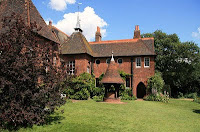
The first change occurred through the invention of machines that mass produced objects . On one hand this was great because it made all these amenities readily available, but to other "true" designers this meant a loss of designs being created by hands which meant a loss of heart and creativity. One such designer, William Morris, took upon himself to change this new age of mechanization and revert back to handcrafted designs...a movement known as the the Arts and Crafts movement. Along with others who followed suit, he altered medieval architecture by incorporating it into the modern designs of the 19th century. The picture to the left is known as the Red House which was designed and constructed by Morris along with his friend Philip Webb. This house showcases the Gothic architecture of old time incorporated into modern design. Everything was hand designed and constructed inside and out by Morris, foregoing the machinery being used in the 19th century. http://www.williammorristile.com/morris_arts_and_crafts.html
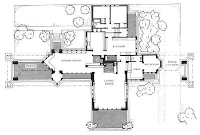
Because of Morris' action to step out of the box, Frank Lloyd Wright followed in his footsteps but decided to put his own twist on the Arts and Crafts Movement. New forms were created into modern, non-traditional houses that had never been seen before. Roth tells us that "European architects...were inspired by his opening up of space and his rejection of traditional forms and building methods." Using Morris' ideas, Wright began to refashion the face of architecture that would be appreciated
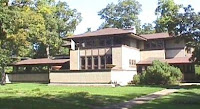
by many decades later. The pictures to the right and left showcase the Ward Willits House. This was the first prairie style house of the 19th century. It has some Japanese influence, but is shaped almost like a Gothic style cathedral (cross design). It just shows how much past architectural concepts influenced even famed designers like Frank Lloyd Wright. He originated his own designs, yet he incorporated classic design styles as well into the modern forms. http://www.delmars.com/wright/flw8-3.htm

The growing trend in modernism sparked the need to have a school with comprehensive teaching and instruction on architecture. Universities opened and they quickly produced immaculate students. One such famous student to come out of Ecole des Beaux-Arts (School o fFine Arts) was Louis Sullivan. He looked at the new trend of tall buildings as having 3 fundamental and purposeful zones. Through this process of thinking, he constructed the
Guaranty Building. Sullivan incorporated his own version of patterns on the outside of the building to emphasize each of his zones. Constructed in 1895, Sullivan said "it must be every inch a proud and soaring thing, rising in sheer exultation that from bottom to top it is a unit without a single dissenting line." Even though this quote was stated over 100 years ago, it still has much truth to it. Modern day architects of skyscrapers build their buildings with character that give it a sense of pride power. That is what Sullivan was communicating with his view on skyscrapers. The Guranty Building is featured to the right and shows off his attention to detail in design along with his designated zones from street to building top. http://www.bc.edu/bc_org/avp/cas/fnart/fa267/sullivan.html

**From this summary, I derive the question...Is there really an original idea or do we just keep altering existing concepts? These architects used past designs but changed them around a bit to create interest and uniqueness. They can't take ALL the credit because some of their thoughts for modern architecture already existed in other forms. Looking at the past gives us inspiration and creativity to put towards a new venture. It expands our thinking beyond our own bias thoughts. In essence, I am leaning towards the fact that we just keep altering existing concepts with the door open freely to change it in any way we want!

Monday, March 28, 2011

BP 10-The Camera

Cameras...the inanimate object that communicates the words and feelings we cannot express

A revolution, as discussed in class, incorporates reform, revival, and a cycle. Cameras have revolutionized in design and features since its inception in the early 1800s. The camera was an on-going invention that took many years to master, but the first photo was taken in 1814. The very first camera was a large box with a hole in the middle to capture the image, and it was constructed from wood! After taking the image, it was incapable of saving the picture so it was rather useless. The image to the left showcases the very first rendition of the invention we use on a daily basis. This invention was the predecessor of technologies to come.

Later in the 1900s, a new design approached the camera industry. The folding montauk was a camera that could be folded up in
to a suitcase. Its lenses were made of glass and all the hardware was made of the highest quality wood and plating. These cameras were extravagant in design and construction. At this time, they were still made from wood, but were a little easier to carry.

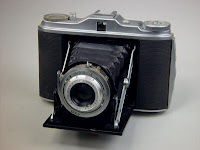
By the 1950s, cameras were no longer made from wood, but metal. They could now be held in your hand and transported easily. It also had the capability to snap photos, zoom, and incorporate a flash without holding the light. The revival of the camera was a completely new object in the 1950s.


In 2011, cameras can be as large as the 1950s camera above such as professional Canon cameras, or they can be as small as your palm. This teeny tiny camera is 2.5x2.3x2.5 cm all with recording and picture taking abilities. The camera has done a complete 360 turn from its beginning. Its reformation has caused a change for the better. We can capture so many moments in history because of the revolution of the camera. Who would have ever tho
ught that the original large box called a camera could be reduced to such a small size and TRIPLE its capabilities in a little less than 200 years?!?! Time can only tell what it will be in 50 more years.


Monday, March 21, 2011

RR 9-Gardens...the icing of architecture

Gardens...the icing of architecture
Roth: 452-458; Ching: 584-585; 588

"All gardening is landscape painting," a quote by Alexander Pope that influenced the English people to transform their gardens into works of art. A movement that would soon be followed by many then and even in present day.

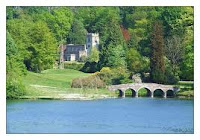
*One of the most well-known and viewable landscapes today is that of Stourhead, England. This was designed by Sir Henry Hoare, who used Claude's Coast View of Delos with Aenas. Using this painting, along with others Hoare simply recreated what he saw on the canvas. He brought it to life..imaginary to reality. These enormous gardens were almost synonymously complicated and elaborated as the actual structure it framed. Taking almost 40 years to complete, Hoare made this his occupation and contribution to future landscape builders.

The picture to the left captures the modern day gardens of Stourhead. Still so picturesque as it was back in the mid 1700s.

Meanwhile in Buckinghamshire, England, the Stowe Gardens were being built and taking a different approach to appreciating its beauty. Touring the gardens by people other than the owners was growing in popularity. The elaborate gardens signified high class and social gatherings. Influenced as well by Alexander Pope, the Stowe Gardens incorporated aTemple of Ancient Virtue and a Temple of Modern Virtue. These structures honored those who had influenced them or had a significant impact on their architecture. The Stowe Gardens also created a bridge for the English to understand the Native Americans. Their gardens allowed them to brand out in their thinking about civilization. The inception of Eurocentrism is believed to have its origins around this time.

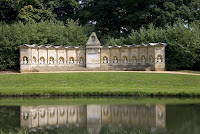
The picture showcases the Temple of British Worthies in the Stowe Gardens. This structure is a monument dedicated to significant people of that time including William Shakespeare, John Milton, Alexander Pope, and many more.


Gardens gained popularity in China as well. Influences from Ji Cheng's Yuan Zhi

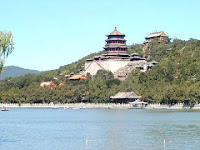
("Gardening") helped the Chinese design such a beautiful garden. The Chinese believed gardens should be in accord with every angle that each person views when walking on pathways. They put their focus on three different elements of the Qingyi garden: an island in the center of the lake, a Buddhist monument at the northern corner, and a tall pagoda on the hills in the west. No matter where you are when walking along the path, all three of these structures can be seen. The gardens in England were first and foremost made for the owner and his household, then bystanders could take in the scenery. The gardens in China differed from England because the Chinese created them for everyone's pleasure and enjoyment.

The picture to the right showcases the Summer Palace in Beijing as it is now called. Very different from England gardens, but still undeniably PICTURESQUE!

*~These artists brought paintings of landscapes to life through physical forms. Once again architecture prevails by recreating the imaginations pictures into real life structures.

Sunday, March 20, 2011

BP 9- Coffee and Skyscrapers


European Influence

Many of our everyday rituals/everyday activities can be attributed to sources we haven't even considered responsible for its inception. Even though countries are separated by millions of miles, they have still managed to impact each other significantly in architecture.

As mentioned in my previous blog, coffeehouses can be considered my "happy place". The concept of a coffeehouse had to start off somewhere and that place wasn't America....its birthplace was in Aleppo, Syria. (Ching, pg. 559) Drinking coffee had a huge social impact on the male population. It initiated conversations about important topics and brought them together. Through coffeehouses, sugar was becoming a staple in Europe's food consumption. As chocolate grew in importance, it turned into a "filler" before lunch/dinner
. What we now call breakfast began with tea and chocolate.
The action of using a coffeehouse as a place to meet up with friends and chat about life has roots all the way back to the mid 1600s. This simple establishment or environment ( as discussed earlier in the semester) has created a ritual across America and continues to flourish where it began. The ideology of men getting together making business deals and socializing in this common space became a normal tendency of everyday life, just as it is today. We don't even really think about drinking coffee in the morning; it's second nature to us.

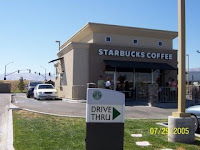
The picture above shows a 1700s London coffeehouse. From its scale you can derive that it was a large meeting area designed for comfort and conversation...much different from our coffeehouses today that are designed for convenience and necessity.


The picture to the right captures a modern
day coffeehouse, better known as Starbucks.


American Influence


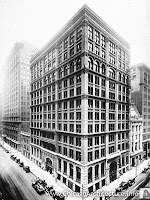
As the Europeans have had influence on American culture, the United States has inspired other countries as well. The city of Chicago is known for having the first skyscraper, the Home Insurance Building. Skyscrapers are a world phenomena that m
any countries have copied and built as a result of American cities building bigger and taller structures. It has become almost a competition to see who can be labeled as having the world' s tallest skyscraper.

This picture captures The Home Insurance Building, what is considered the world's first skyscraper.

http://www.chicagoarchitecture.info/Building/3168/The-Home-Insurance-Building.php
As discussed in class: "there exist a normally hidden set of rules, codes, and convent
ions through which meanings particular to specific social groups are made universal." This statement is so true in regards to skyscrapers. The only reason, with the exception of aesthetic value and possibly saving space, skyscrapers are continually built is because of the notion to be the best and most-innovative in structures. Simple things such as this signify power. This will always be the case among countries. We can learn something from everyone though. That is how greatness is born.

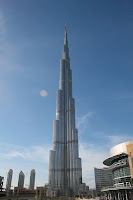
Burj Dubai in India is currently the tallest building in the world at 2, 716 feet. Obviously, we have come a long way from where we started in Chicago, but it just shows that our influence was significant on the world of architecture.


Sunday, March 13, 2011

RR 8-Ceilings- the physical limits of a building yet the openings of the structure

Ceilings-the physical limits of a building yet the openings of the structure
Roth: 404-406; Ching: 538-542


*Roth says: "Reason has been overpowered by mystical experience". When art captures the viewer it encompasses all aspects of the appreciator and takes them into a new experience. Reasoning goes out the window, and you are brought into a new realm. For that split second, you are somewhere else with a different perspective. Ceilings are just one aspect of architecture, but they have the power to as the quote says overpower your reason.


Padre Andrea Pozzo painted the vaults in the Church of San Ignazio in Rome. This artist completely took away any evidence of curvatures in the ceiling. The viewer's eyes are captured by th
e story-telling picture of clouds, angelic figures, and the inviting sky. The painting erases any barriers or columns built into the church. These wall to ceiling paintings were the predecessor to ceilings being one of the main focal points in architecture.

>>Featured to the left is Pozzo's fresco vault in Rome showcasing his immense detail a
nd ability to erase barriers on a ceiling and invite the viewer into a "whole new world".

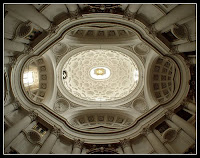
San Carlo alle Quattro Fontane has a ceiling that captures this concept as well. It features crosses and ovals circling an inner oculus. The columns draw the eye to the ceiling into what almost seems like an oasis. The sunlight radiates the pattern that is so well constructed. Featured to the right is Borromini's San Carlo alle Quattro Fontane. You can see the columns leading up to the oval ceiling design. The crosses and ovals in the design cr
eate a liquid movement for the viewer.


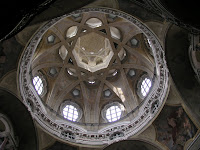
Architect, Guarino Guarini designed an impeccable ceiling in San Lorenzo located in Turin, Italy. Composed of piers, diagonal arches, and circular windows, San Lorenzo commands attention upwards. The arches create a pushing effect, as if they are holding the octagon oculus in place. The base of the circle creates what looks like a balcony even though there isn't one.

<

These are just a few artists that took their art to even the utmost level of the structure. The ceiling serves 2 purposes: to keep out the rain and bring in the sun. I think it is amazing to see ceilings like this. Architecture is just not made like this anymore. During this time, every aspect of the churches had a story to tell. Even necessary parts of a building can be the most striking.


Sunday, February 27, 2011

RR 7-Be the change you wish to create in the world

Be The Change You Wish To See In The World
Roth: pgs. 353-362

"The Italians..began to view history in a new way. They perceived human history not as a divinely ordained continuum but as a series of successive periods, some characterized by great human accomplishment." They combined their intellect with design to change the way architecture was developed. Mathematics and human dimensions were now being incorporated into building dimensions. The Italians took a step out of the box to bring about something new and innovative. It proved successful. A lesson to be learned in all areas of life!

  • The first thing they revolutionized in architecture was the direction that one’s eye

    travels. The Romans caused the eye to move up and down; the Italians decided to build their designs around horizontal and vertical components, which resembled human proportions. Traditional architecture was being thrown out the window, thus begins the RENAISSANCE.

    >>>The Egeskov Castle in Denmark is an example of Renaissance architecture, but also it is a representation of how the eye travels across instead of up and down. Just one of many examples of stacking and layering in design. http://www.everyculture.com/Cr-Ga/Denmark.html

  • The second innovation to architecture began with Brunelleschi's Dome of Florence Cathedral. This structure was built using design elements that had never been utilized before. The Dome of Florence marked a huge stepping stone for Italy. A quote made by Leon Alberti, humanist scholar and theorist: "We discover unheard-of and never-before-seen art and sciences without teachers or without any model whatsoever." Brunelleschi was willing to think differently about architecture having no guide or blue print to follow. His design was pure inspiration, his interpretation of the outside world.....BUT isn't that what design is intended to be?
>>>>Overtaking the skyline in Florence, Brunelleschi's Dome showcases its uniqueness and separation from all the other buildings. It commands attention and it is granted. There is nothing else that comes close to this innovation. The Dome also uses its fellow architectural neighbors to remain unified with them by using the same roof color and materials.
  • The third advancement made during the Renaissance was Vitruvius's Ideal Form. His ideas were formulated through the guidance of Plato's book Philebus. This book discussed how forms can be made simply by lines and circles, and in turn how these shapes are then viewed as three dimensional. Once again, Vitruvius conceptualized that "ideal systems of proportion...can be found in the perfect proportions of the human body." He formulated how the human body is essentially made up of shapes as well. This began a movement of architects using the human body proportions as a basis for design. Circles were highly utilized because the Romans believed the eternity of a circle represented the Deity of God. These architects used already existing forms to design completely new architectural concepts.
>>>Leonardo da Vinci's capture of the Vitruvian Man...just a photo to reemphasize the idea that the ideal system of proportion is manifested through the human body proportions. Square inscribed in a circle showcases the equality to the man's arm length and height. http://jancology.com/blog/archives/2004/06/06/the_vitruvian_man.html

What these architects accomplished was almost an entrepreneurial venture in the world of architecture. They reached a whole new level of design concepts that we still use today. They broke the status quo. This idea can be transferred to anything in life, not just architecture. If you want something different, DO IT!