Tuesday, May 10, 2011

First day in Charleston


My first day as the Style Intern at the Charleston Magazine was A-M-A-Z-I-N-G! I was trained by the past intern; then left to my own! I began the day with 2 assignments from my boss/style editor. I had to compile 10 men's and women's fall 2011 looks for the fashion to furnishings feature in the Charleston Home magazine. Second assignment consisted of scouting Charleston retailers for the July issue feature on children's swimwear. When I'm not in the office I will be on the streets of Charleston snapping photos of fashion forward individuals to feature in our Street Style section of the magazine or picking up samples that Charleston retailers are allowing us to borrow for the photo shoots. I will also be assisting our Style Editor on all photo shoots and attending events with her occasionally.

On Thursday, I will be attending the ribbon cutting of Studio Charleston. Many movies are produced and filmed in Charleston, but Studio Charleston will now officially be the production warehouse for all movies and I get to GO. Thanks to my cousin/uncle/summer-dad, Martin who I am staying with. He is my mom's cousin and he has graciously invited me into his home for the summer, but he is more like the definition of the typical "cool, complete Southern-gentleman" uncle I would have.

Charleston is impeccably beautiful, and I can't believe that I am here to not only work but spend my summer as well. I am very grateful for everything, and I have already met some wonderful and hospitable people. If you are in Charleston, definitely come and visit with me. More updates to come...:)

Monday, April 25, 2011

US3-EXPLORATIONS

As described in the unit's heading, this section did indeed deal with explorations but more than that it was about discovering the meaning and purpose of architecture. Should its purpose be solely utilitarian, stylistic, or can it be both? The design forms of this unit had never been seen before nor explored. As the "rules" from the east and west fizzle out, stylistic approaches quickly change to a free, limitless world of design.

We open up the unit into the first World's Fairs. These expositions showcased art and design from around the world in one central location. It was more than just an exhibition of the best of the best...it was a collaboration of separate worlds into one. The fair was also a celebratory event that recognized world evenths, interests, and changes. The city that was selected to host the world's fair automatically put a footnote into history for that country. Similar to the Olympics, this was a monumental event that was not to be taken lightly. The celebration of nations began here. The arts and craft movement began to form around this time. This was about whether architecture should be essentially "mass produced" or stay true to its roots of handcrafting. William Morris penned the quote: " Good design for all" He was communicating that design should benefit everyone with both a stylistic and utilitarian purpose. His belief was that all designers and architects have a social responsibility to create something that can be appreciated by each person designer or not. This brings us to the movement after modernism. Artists such as Seurat, Cezanne, and van Gogh began to play with the idea of light and material. This created art with a true feeling of emotion and feeling. Forms were harder to decipher and instead of lines finishing the picture, it was left to the viewer to complete the artists' thoughts and visions.

Enter Art Nouveau: a movement of natural, curvilinear lines and natural materials. This design form allowed your eyes to travel instead of just focusing on one aspect of the painting or architecture. This began in France and traveled over to America in the form of art deco. Exteriors and interiors began to look like skins. This trend was apparent in such skyscrapers and centers as the Empire State Building and Rockefeller Center.

Modernism came back into popularity with architects such as Ludwig Mies van der Rohe and Le Corbusier. This time modernism concepts were accompanied with problems. Buildings were criticized to all look alike and lack uniqueness. Classrooms on campuses all looked the same and lacked character. Glass box forms became popular by Mies van der Rohe and he took it to another level through the Chicago Lakeshore apartment buildings. Philip Johnson combined both modernism and art deco. He said: "Purpose is not necessary to make a building beautiful." He designed solely for the purpose of aesthetic value. Design was changing and rules were no longer in existence. This is apparent in Bruce Goff's Bavinger Houde in Norman, Oklahoma. Its appearance resembles a nautical theme but its location is no where near water. Modernism was beginning to not take its surroundings into consideration as it had in the past. Fast forward a couple years to the U.S. Air Force Academy Chapel in Colorado Springs and it clearly resembles plane wings with Gothic influence. By this time, anything was fair game. Designers began to get creative and make their creations parallel to the purpose of the building. The College Life Insurance Building in Indianapolis resembles pyramids from Egypt. Preservation of life is
what the pyramids stood for so the design of this building is appropriate and almost comical.

Louis Barragan: "How can one forget joy? I believe a work of art reaches perfection when it conveys silent joy and serenity." This quote stuck out to me because I think it communicates the very essence of the purpose of architecture. It not only wraps up the unit well but also the theme of this class. Architecture has never spoken to me on an emotional level, and now I can see it through different eyes. It may even take me to the place of joy and serenity. The unit was about explorations, and this time of trial and error for architecture from arts and crafts all the way to modernism was about discovery. I chose Le Corbusier's Villa Savoye to illustrate this unit because I think it incorporates modernism and art nouveau aspects. The eye travels across the whole house whether you are looking at it from above, below, or ground level. It's modern because of roof garden and free plan. It is untraditional with its base on stilts instead of concrete.
It is open to nature on all sides. It also forms around a car's turning radius as discussed in class, which is ingenious design. This was built in 1929, which was before modernism began its second phase. He was ahead of design time to me, and this house
is timeless...a form and design to be followed by many.

BP 14-My inspirations

It's crazy how inanimate objects, places, buildings, and spaces can influence us in so many aspects of our lives and decisions. The memories we hold dear from childhood to present day most likely revolve around one of these inanimate things. As a result, our design approach and personality are revealed through these events/life changing moments.

My favorite space to draw inspiration from is the Barnes and Noble cafe. I myself don't really understand why I feel so at peace when I go here. I could go to the cafe and feel comp
letely uninspired, but then after sitting there for awhile and maybe a little too much people watching I suddenly know what to write about. It's silly, but when I am there I feel like I'm among the most elite. I can literally sit there for hours and in a completely different world.http://www.tampabay.com/news/growth/article950296.ece

The place that inspires me most is Chicago. Since I use to live there, I am probably part bias to how amazing of a city it truly is. In the midst of the bustle of Chicago, I feel peace and wonder. When you are in the middle of that city, it's like the world is at my fingertips. I can accomplish, dream, and be anything I want. Chicago, to me, is a beacon of light of things to come. Picture taken by me: the city at night..complete with wind and snow during Christmas of 2008.

An object that inspires me would be my ipod. Music is such a big part of my life that it instantly changes my mood and mind. A song could come on and the stress in my life doesn't seem so big anymore. Or a song could take me back years from the present moment to a memory or event that occurred. This little instrument has the capabilities to make me think differently and that is inspirational in itself.

The building that gives me the most inspiration of all things in life is my home church here in Greensboro, Cornerstone Baptist Church. The building itself is not the source of where inspiration is stemmed, but it houses it. All the answers and questions to life are revealed to me here through the words of our pastor. He is an instrument being used by God. I don't feel anymore complete than when I am at church worshiping God. He is the reason I live, breathe, and accomplish anything in my life; therefore my inspiration is at its fullest when I am here. http://www.flickr.com/photos/marty4650/3805952911/


Monday, April 18, 2011

extra credit-Two Views of Design

Education vs. Natural Talent
Does an Education really matter in interior design?

Education in interior design weighs pretty heavily in the grand scheme of things. An education opens your eyes and your brain to a completely different world. You get exposure to people from all walks of life and professors/educators with experience you can only get at a university. The projects and assignments you are given will burst open creativity outlets you didn't know existed or would have never used otherwise. Interacting with other people of similar interests will broaden your design ideas and give you an open mind to other avenues. BUT does that mean that you cannot be a successful interior designer without an education? Unfortunately some people are going to only hire those with an education because it serves as a credential. You could present your client with an immaculate plan, but he may choose to go with someone else simply because of a degree. If we look at design as a whole though does the degree really matter if the person is just as talented possibly better than someone WITH a degree? I would say no it shouldn't matter. The degree doesn't define the person's ability and ingenuity; it just communicates that you can finish something. The designer's experience and life skills definitely shape what they bring to their profession. Whether they have an education or are a design star life experiences shape that person to who they are today, how they view situations, and their design style. The media definitely plays a huge role in marketing interior design. Media creates automatic credibility. When someone has seen that you have been recognized by media or other famous people, it immediately boosts that person's quality points. This doesn't mean those who haven't been recognized by media are not good, it just means that it definitely doesn't hurt them either.
Honestly, education to me in interior design doesn't matter because if you have the talent then you have it. An education DOES help but it also is really important to be confident in yourself and know that you are good at what you do...education or not. The degree doesn't make you...you make you!


BP 13-Gateway Arch

Gateway Arch to Westward Expansion

Eero Saarinen designed the famous Gateway Arch in St.Louis, MS that currently blankets the sky with its enormity. To this day, it still remains the tallest man-made monument in the United States after almost 50 years. As a marker for the growth of westward expansion in the U.S., the Gateway Arch serves as a symbol AND architectural phenomenon for all to see. It flocks over the city of St.Louis, specifically over the Jefferson National Expansion Memorial. With Saarinen being the initiator of this project, America was exposed immediately to his work and talent. Such a large feat this monument was that the U.S. could only be inspired by his immaculate work on the Gateway Arch. At this time, skyscrapers were still being mastered through trial and error. Watching Saarinen use techniques and design from Finland and Switzerland exposed America to a different style of architecture. Since he was the son of Eliel Saarinen, he also got to incorporate his father's acclaimed designs as well into the Gateway Arch.

Scandinavian culture is much different than American culture, which automatically means their architecture will be dissimilar as well. Learning from other countries is essential when creating new ideas and concepts. We can learn from them what has worked and what has not. The arch in St.Louis is such an icon now not just for St. Louis, but for all of America. It symbolizes growth and expansion throughout North America. It weighs symbolically on America as a nation. To me it is almost welcoming everyone in the most uncanny way. I feel that America would be missing out on a symbol if it weren't for Saarinen's inspiration to communicate the U.S.'s expansion at that time.

RR 13-l'architecture parlent

Speaking Architecture
Roth: 537-561

Lewis Mumford spoke volumes when he stated in his essay that it was "not enough for a contemporary building simply to be something and do something; it must also say something." As Roth communicates to us in his book...this quote from Mumford reverts directly back to the concept of commodity, firmness, and delight. As Modernism continues to rise, we see parallels in past, present, and future ideas. Was and is architecture more than just necessary for functional purposes or is there something more meaningful underneath all the bricks and mortar?

Scandinavian artist Alvar Aalto stated that architecture is "still the same great synthetic process of combining thousands of definite human functions and remains architecture. Its purpose is still to bring the material world into harmony with human life." Prior to taking this class, I never once looked at architecture as encompassing human aspects and characteristics. Since being in this class, I now see the architectural world around me through different eyes. Aalto knew he could create something funtional and beautiful at the same time. He found the balance that many couldn't. He designed in a way that everything is connected...space, light, people, and the structure itself. Aalto only built 2 buildings in America..the rest reside in Finland where he is
originally from. The Mount Angel Abbey Library in Oregon demonstrates Aalto's command of architecture. The skylights bring in the daylight and at night showcase the starry nights. It contains only furniture and original designs by him. The functionality is appropriate as well for its use as a habitat for books.
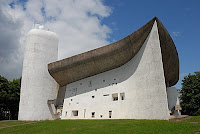
Another Swiss architect, Le Corbusier created something only a true designer could have completed. He recreated the French Catholic Church, Notre-Dame-du-Haut since it was destroyed after World War II. The ingenious thing is not that he reconstructed it, but that he was not even Catholic yet the building was so sacred and inspired. Le Corbusier said: " the feeling of the sacred inspired our efforts.
"It didn't matter if he didn't believe or agree with what the building was going to be used for; he still put all his efforts forward to make it exactly what the members of that church needed it to mean to them. He almost took on their role, in order to know how they envisioned their church. I think a true designer learns what the client wants, but molds his vision around theirs as well. The picture to the left showcases the Notre-Dame-du-Haut by Le Corbusier. The construction of the building is so unique and one-of-a-kind for a church (I would have never guessed it was a church). The upward reaching peak is almost like a typical church's steeple pointing towards heaven, which is ironic.
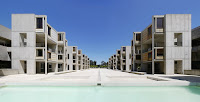
After two Swiss architects, an American finally rose to the trend of humanism and modernism. That American was Louis Kahn, who attended the Ecole des Beaux-Arts. He "viewed the purpose of architecture as elevating human institutions and human activity to an almost metaphysical plane. As the others, he utilized both form and function to create the Jonas Salk Institute for Biological Studies. This institute (pictured to the right) encompasses human activity conducive to its purpose. It is a place for discovering and exploring new things, and this building is communicating that with its different levels and intrigue. The Jonas Salk Institute speaks its purpose to its inhabitants and those outside of its circle. http://figure-ground.com/salk/

In the beginning, the question addressed was is there more meaning to architecture than just surface? These architects clearly demonstrated that there is a whole other aspect to architecture than just function. You basically can't have meaning without function. It has to speak something for it to even matter in the end. If it is just a building without meaning it truly has no purpose. It is weird to be saying this since I have never thought in terms like this. True architects have to have the inspiration along with the design and uniformity with the world around it or it won't make sense. Only few have been able to truly grasp those ideas.


Monday, April 11, 2011

BP 12-"Good Design for All"

William Morris conceptualized the idea of having "good design for all". The vagueness of this statement leaves the door open for it to be applied to anything and everything. I believe he meant that design of any building, space, place, or object has accomplished its purpose IF and only IF it can be enjoyed and appreciated by everyone from all walks of life.

One object in particular that I believe represents the essence of this statement would be the design and invention of the telephone. This is definitely one of the most ingenious and useful objects ever created in my opinion. It is crazy to think that a simple device with no cords/strings attached alllows us as humans to communicate in such a simple way within seconds. The phone connects people that are millions of miles away. Not only does it call people, but now it has over 50+ options to perform other tasks. When you are separated from someone, a phone call can immediately change your mood. The telephone allows every emotion you have to be touched. No matter what part of the world one is from, they will use the phone as a part of their everyday life. It is very hard to imagine what life would be like without this connection. For me personally, I am on my phone constantly because it is the only way to know how my family and friends are doing. Of course you can adapt to not having the extras in life, but it would be very difficult. It would actually pain me if I didn't have a phone to call people I don't see on a regular basis.
When I see someone calling that I love, I get so excited. How many times a day do we wait for our phone to ring or to receive a text? All because of this invention/design..it has us connected but it also makes us crazy because we are on it so much! When Alexander Graham Bell invented the phone, he wanted to connect the world around us. He accomplished that, and he designed for all in mind. Everyone can appreciate the telephone, and everyone can use it in good times or bad times.